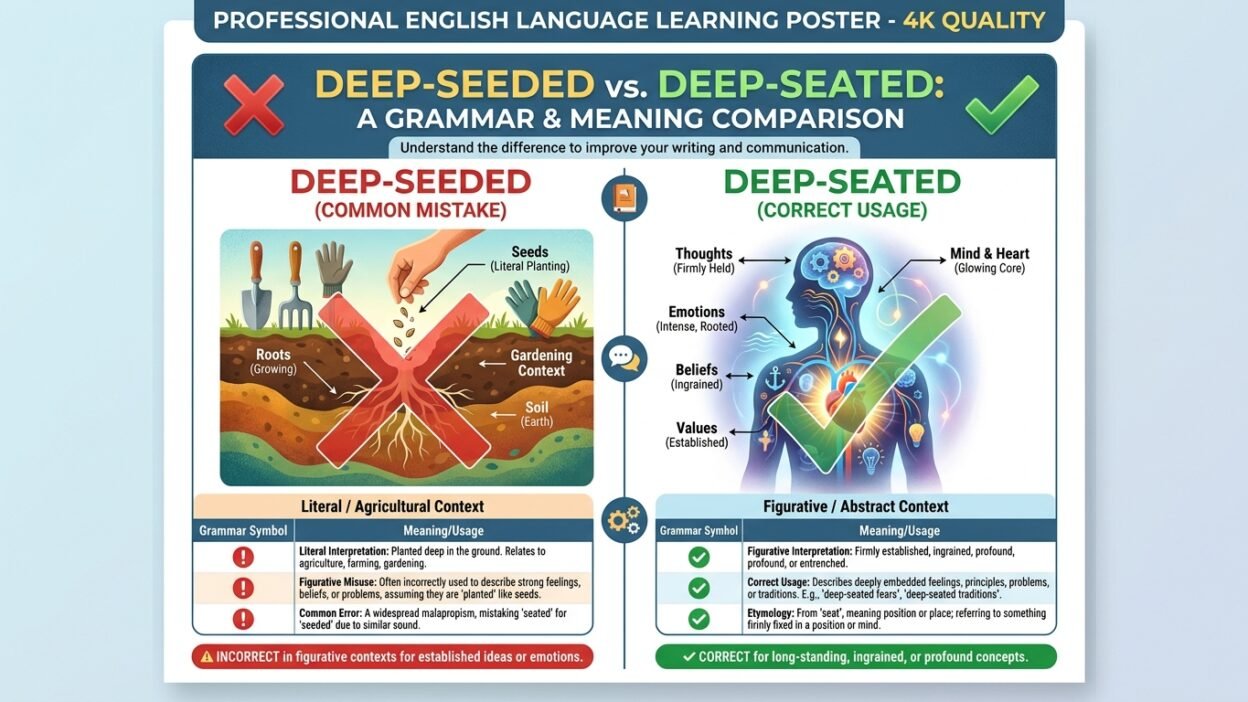
Many learners struggle with deep-seeded vs deep-seated because both forms look similar, yet only one follows standard English usage correctly. In my experience teaching grammar, this common mistake appears often in writing and everyday communication because people connect the idiom with gardening, seeds, roots, dirt, and things buried in the ground. This misunderstanding comes from tracing back the phrase to plant growth, but that idea reflects incorrect usage. In modern language and English expression, deep-seated is the correct form, an adjective created by combining words with a hyphen, and its meaning points to something seated deeply within a person rather than something planted in soil.
The phrase deep-seated usually describes a deeply rooted belief, deeply held belief, strong belief, emotional belief, or inner belief that exists within a person’s core or heart. Such a belief remains fixed firmly within and is not physically buried within the earth. Understanding proper word choice, proper usage, correct usage, and recognizing differences from incorrect usage can improve grammar, vocabulary, and overall clarity. The present form accepted in standard English is deep-seated, while deep-seeded usually comes from confusion with deep seeding and things that grow naturally from the ground.
While teaching grammar, I have found that learners remember the distinction more easily when separating images of things buried, deeply buried beneath dirt from the actual expression. Although weather, gardening, and planting may make the comparison seem logical, the expression refers to thoughts, feelings, and beliefs that stay deeply rooted inside a person. Learning this distinction strengthens grammar skills and supports more accurate communication.
Quick Answer
| Expression | Correct? | Meaning |
| Deep-seated | ✅ Yes | Firmly established, strongly held |
| Deep-seeded | ❌ Usually No | Common mistake based on confusion with seeds |
Easy Rule
- Use deep-seated when talking about beliefs, feelings, fears, habits, or opinions that are firmly fixed.
- Avoid deep-seeded in standard writing.
- Think of seated as something sitting firmly in place.
Simple Background
The confusion comes from the way people understand the phrase.
Many people hear deep-seated and imagine something growing from deep within the ground. Because seeds are planted in soil, they mistakenly replace seated with seeded.
The original expression comes from the idea of something being seated deeply within a person. In other words, a thought, feeling, or belief is sitting firmly inside someone’s mind or heart.
Over time, many people began using deep-seeded, but traditional English grammar still recognizes deep-seated as the correct form.
Understanding the Difference
The difference between these two expressions is actually very small.
What Does Deep-Seated Mean?
Deep-seated describes something that is firmly established and difficult to change.
It is often used for:
| Deep-Seated Examples |
| Deep-seated beliefs |
| Deep-seated fears |
| Deep-seated emotions |
| Deep-seated habits |
| Deep-seated opinions |
| Deep-seated traditions |
These things are deeply fixed within a person or group.
What Does Deep-Seeded Mean?
Deep-seeded is generally considered a mistaken version of deep-seated.
People create it because they connect the phrase with:
| Seed-Related Ideas |
| Seeds |
| Roots |
| Soil |
| Gardening |
| Plant growth |
| Nature |
While the image may seem logical, it is not the accepted expression in standard English.
Comparison Table
| Feature | Deep-Seated | Deep-Seeded |
| Standard English | Yes | No |
| Commonly Accepted | Yes | Usually No |
| Related to Beliefs | Yes | Sometimes Used Incorrectly |
| Related to Feelings | Yes | Sometimes Used Incorrectly |
| Related to Habits | Yes | Sometimes Used Incorrectly |
| Shows Something Firmly Fixed | Yes | Intended but Incorrect |
| Found in Formal Writing | Yes | Rarely |
| Found in Academic Writing | Yes | Usually Avoided |
| Origin | Seated Deeply | Confused With Seeds |
| Recommended Usage | Use It | Avoid It |
Which One Should You Use?
The answer is simple.
Use Deep-Seated When:
| Situation | Example |
| Strong belief | A deep-seated belief |
| Long-term fear | A deep-seated fear |
| Strong emotion | Deep-seated anger |
| Old habit | A deep-seated habit |
| Personal opinion | A deep-seated opinion |
Avoid Deep-Seeded When:
| Situation | Better Choice |
| Formal writing | Deep-seated |
| School assignments | Deep-seated |
| Business emails | Deep-seated |
| News articles | Deep-seated |
| Professional communication | Deep-seated |
If you are unsure, choose deep-seated.
Common Mistakes People Make
1: Thinking It Comes From Seeds
❌ She has a deep-seeded fear of failure.
✅ She has a deep-seated fear of failure.
The fear is not growing from a seed. It is firmly fixed in the person’s mind.
2: Using Deep-Seeded in Formal Writing
Many learners use deep-seeded because it sounds natural.
However, teachers, editors, and grammar guides generally prefer deep-seated.
3: Assuming Both Are Equal
Some people think both forms are equally correct.
In standard English, deep-seated remains the preferred expression.
4: Forgetting the Original Meaning
Remember that the phrase comes from something being seated deeply within a person, not planted in the ground.
Everyday Examples
In Emails
| Example |
| She has a deep-seated concern about the project. |
| His deep-seated belief affects his decisions. |
In News Writing
| Example |
| The community has deep-seated concerns about safety. |
| The issue reflects deep-seated social problems. |
On Social Media
| Example |
| Many people have deep-seated opinions about the topic. |
| The discussion revealed deep-seated emotions. |
In Daily Conversations
| Example |
| She has a deep-seated fear of heights. |
| He has deep-seated confidence in his abilities. |
In School Assignments
| Example |
| The character shows deep-seated anger. |
| The story explores deep-seated family issues. |
Learning Tips for Students and Beginners
Easy Memory Trick
Think of the word seated.
Something that is seated is sitting firmly in place.
A deep-seated belief is a belief sitting firmly in your mind.
Quick Reminder Table
| Word | Memory Tip |
| Deep-Seated | Sitting deeply inside |
| Deep-Seeded | Think of seeds, usually incorrect |
Practice Method
Create your own sentences using:
- Deep-seated belief
- Deep-seated fear
- Deep-seated habit
- Deep-seated opinion
- Deep-seated feeling
The more you practice, the easier it becomes.
FAQs
Is deep-seated correct?
Yes. Deep-seated is the accepted form in standard English.
Is deep-seeded wrong?
It is generally considered a mistake or nonstandard form.
Why do people say deep-seeded?
People often connect the phrase with seeds, roots, and plant growth.
What does deep-seated mean?
It means firmly established or strongly held.
Can I use deep-seeded in school writing?
It is better to use deep-seated because teachers usually expect the standard form.
Is deep-seated used for emotions?
Yes. It is commonly used for emotions, fears, beliefs, and opinions.
How can I remember the difference?
Think of something seated firmly inside a person rather than planted like a seed.
Which expression should I always choose?
Choose deep-seated whenever you want the standard and widely accepted form.
Conclusion
Understanding deep-seeded vs deep-seated is easier once you know the original meaning. The correct expression is deep-seated, which describes beliefs, emotions, habits, and opinions that are firmly established and difficult to change. Although deep-seeded may sound logical because of its connection to seeds and growth, it is generally considered a mistaken version. Remembering that something is “seated” deeply within a person will help you use the correct expression every time.