Many learners struggle with discrete vs discreet because these homophones are among the most commonly confused words in English, creating confusion through similar spelling and usage. While teaching English language skills, I often notice word confusion because these homophone pairs and similar pairs look nearly identical in writing. This creates trouble for both beginners and experienced learners, especially when they only hear the words without enough context. Understanding the difference between them requires attention to meaning, meanings, and whether the word appears in a written context or spoken context.
Strong reading, listening, and careful observation help learners improve recognition of these similarly spelled words. Through regular practice, learners and students develop a better understanding of which word belongs in a sentence based on its intended use. This process improves understanding, builds vocabulary, and strengthens communication. Learning the distinction between these words is also an important step toward mastering grammar and improving overall word usage.
In my experience, focusing on correct usage instead of memorizing definitions leads to faster progress. Understanding how discrete and discreet function in everyday language helps avoid incorrect usage and supports more natural communication. Careful interpretation of a sentence and its surrounding context improves accuracy, builds confidence, and reduces common spelling mistakes caused by similar spelling.
Quick Answer
| Word | Meaning | Easy Memory Tip |
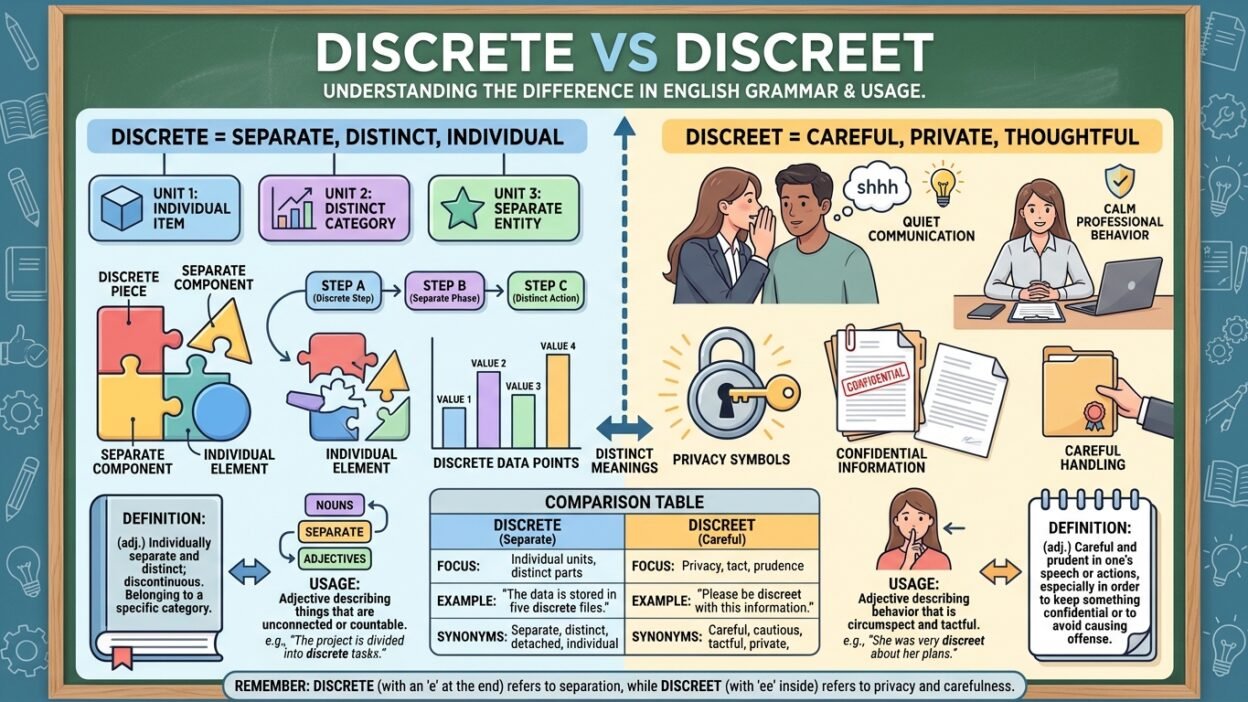
| Discrete | Separate, distinct, individual | Think: Separate pieces |
| Discreet | Careful, private, not drawing attention | Think: Quiet and careful |
Quick Rules
- Discrete = separate things.
- Discreet = careful behavior.
- Discrete talks about objects, groups, or items.
- Discreet talks about people and actions.
Simple Background
Both words come from the same historical root, but their meanings changed over time.
As English developed, the words took different paths.
| Word | Developed Meaning |
| Discrete | Separate and distinct |
| Discreet | Careful and thoughtful |
Today, they have completely different meanings even though they still look very similar.
That is why they are considered one of the most commonly confused word pairs in English.
Understanding the Difference
What Does Discrete Mean?
Discrete means separate, individual, or distinct.
When something is discrete, it is not connected to something else.
Examples of Discrete
| Sentence | Meaning |
| The project has three discrete parts. | Three separate parts |
| The report discusses discrete topics. | Different topics |
| The computer stores data in discrete units. | Separate units |
| The company has discrete departments. | Individual departments |
| The teacher divided the lesson into discrete sections. | Separate sections |
A simple way to remember this word is:
Discrete = Separate
What Does Discreet Mean?
Discreet means careful, private, and respectful.
A discreet person avoids drawing attention and handles situations wisely.
Examples of Discreet
| Sentence | Meaning |
| She was discreet about the surprise. | She kept it private |
| The manager gave discreet advice. | Careful advice |
| He made a discreet exit. | Quiet exit |
| They remained discreet during the discussion. | Careful behavior |
| The hotel offers discreet service. | Private service |
A simple way to remember this word is:
Discreet = Careful
Comparison Table
| Feature | Discrete | Discreet |
| Main Meaning | Separate | Careful |
| Used For | Things, objects, groups | People, actions, behavior |
| Related Idea | Individual parts | Privacy |
| Focus | Separation | Caution |
| Describes | Items, sections, units | Actions, decisions |
| Example | Discrete categories | Discreet behavior |
| Opposite Idea | Connected | Openly noticeable |
| Easy Memory Tip | Separate pieces | Quiet and careful |
Which One Should You Use and When?
Use Discrete When Talking About Separate Things
| Situation | Example |
| Different sections | Discrete sections |
| Separate groups | Discrete groups |
| Individual categories | Discrete categories |
| Distinct parts | Discrete parts |
| Independent units | Discrete units |
Use Discreet When Talking About Careful Behavior
| Situation | Example |
| Keeping a secret | Discreet handling |
| Professional behavior | Discreet response |
| Privacy matters | Discreet service |
| Sensitive information | Discreet communication |
| Personal issues | Discreet discussion |
Easy Test
Ask yourself:
Am I talking about separate things?
→ Use discrete
Am I talking about careful or private behavior?
→ Use discreet
Common Mistakes People Make
1: Using Discreet for Separate Things
❌ The report contains discreet sections.
✅ The report contains discrete sections.
Reason: The sections are separate, not careful.
2: Using Discrete for Careful Behavior
❌ She was discrete about the secret.
✅ She was discreet about the secret.
Reason: The sentence describes careful behavior.
3: Relying Only on Sound
Both words sound very similar.
Many learners choose the wrong spelling because they focus only on pronunciation instead of meaning.
4: Forgetting the Memory Trick
| Word | Memory Hint |
| Discrete | Separate |
| Discreet | Secretive and careful |
Remembering this simple trick prevents most errors.
Everyday Examples
| Example |
| The project includes several discrete tasks. |
| Please be discreet when discussing this issue. |
| Example |
| The study examined discrete groups of participants. |
| Officials handled the matter in a discreet manner. |
| Example |
| The app organizes information into discrete categories. |
| Please remain discreet when sharing personal details. |
| Example |
| The lesson contains discrete units. |
| The counselor offered discreet guidance. |
| Example |
| These are discrete problems requiring different solutions. |
| He remained discreet during the conversation. |
Learning Tips for Students and Beginners
2. Memory Trick
Look at the extra letters.
| Word | Memory Connection |
| Discrete | Separate items |
| Discreet | Secret behavior |
Notice that discreet contains double “e”.
Think:
Extra E = Extra Care
This helps many students remember that discreet relates to careful behavior.
1. Memory Trick
Create Your Own Sentences
Practice with:
| Discrete | Discreet |
| Discrete categories | Discreet employee |
| Discrete groups | Discreet response |
| Discrete units | Discreet service |
| Discrete sections | Discreet conversation |
Writing your own examples helps the difference stay in your memory.
FAQs
Is discrete the same as discreet?
No. They have different meanings.
What does discrete mean?
Discrete means separate, distinct, or individual.
What does discreet mean?
Discreet means careful, private, and respectful.
Which word is used for privacy?
Discreet is used for privacy and careful behavior.
Which word is used for separate parts?
Discrete is used for separate parts or categories.
Why are these words confusing?
They look very similar and sound almost the same.
Can I use discrete for a person?
Usually no. Discrete normally describes things, groups, or parts.
How can I remember the difference quickly?
Remember:
- Discrete = Separate
- Discreet = Careful
Conclusion
Understanding discrete vs discreet becomes much easier when you focus on the meanings rather than the spelling. Discrete refers to separate or distinct things, while discreet refers to careful, private, and thoughtful behavior. By using the memory tricks, comparison tables, and examples in this guide, you can confidently choose the correct word every time.