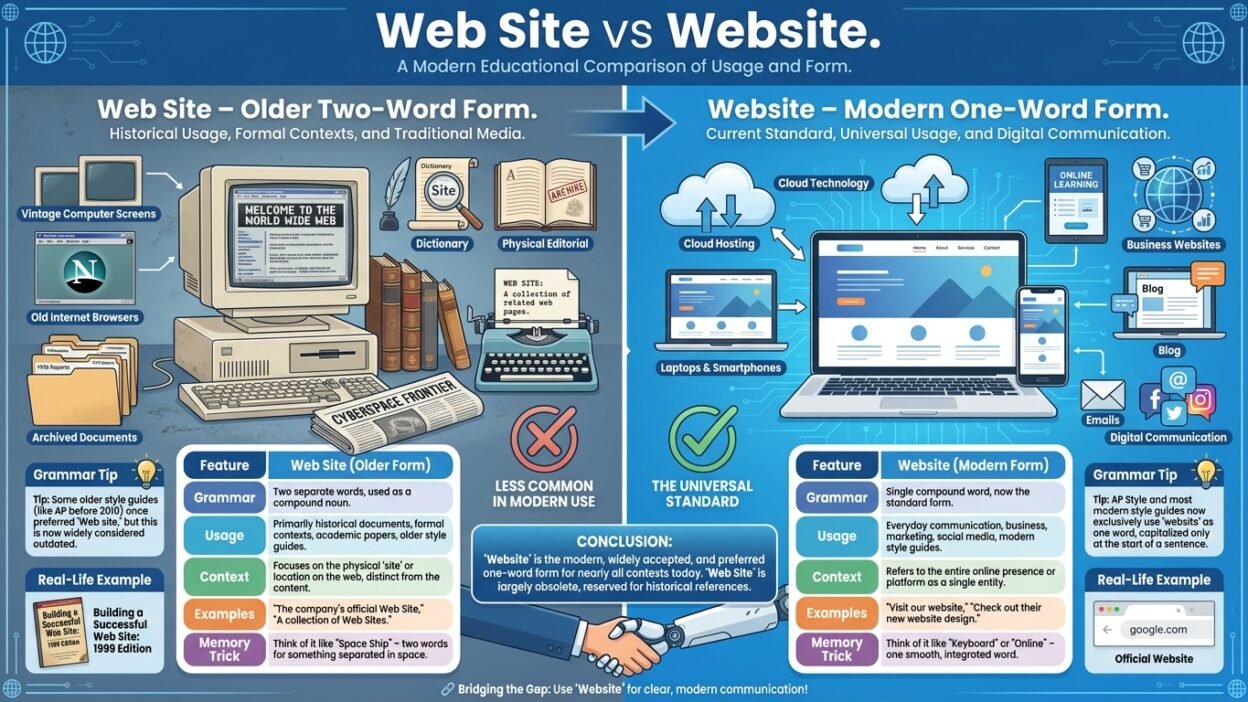
While teaching English, I often explain that web site vs website becomes much easier to understand once you know how language and editorial style have changed over time. Many learners wonder whether to use web site, Web site, or website, but in modern English, the one-word form has become the preferred spelling across the English-speaking world, while the two-word form is mostly viewed as a relic from the 1990s that has fallen out of favor because website now prevails by an overwhelming margin in many publications.
There are still exceptions, especially in American sources influenced by The New York Times, where Web site with a capital W continues to appear in some editorially conservative publications and closely edited sections. However, the uncapitalized website is commonly accepted in blogs and web-only sections. From my experience, learning this spelling variation improves writing, grammar, communication, and confidence instead of creating confusion over changing tech terms.
Although the older spelling is now rare, its continued usage shows the lasting influence of respected publications and their traditional spelling choices. Understanding when each form appears helps learners write more naturally and choose the style that best fits their audience.
Quick Answer
| Question | Answer |
| Which spelling is preferred today? | Website |
| Is web site incorrect? | No, but it is older and less common. |
| Which spelling should students use? | Website |
| Which spelling appears in modern writing? | Website |
| Are both spellings understood? | Yes. |
| Which spelling is best for formal writing today? | Website |
Easy Rule to Remember
- Use website in school assignments.
- Use website in business and professional writing.
- Use website in blogs, articles, emails, and reports.
- You may still see web site in older books or traditional style guides.
A Simple Background
When the internet first became popular, many people wrote the word as Web site or web site because it was seen as two separate words: Web and site.
As English changed, writers and editors began joining the two words together. Over time, website became the normal spelling because it is shorter, easier to read, and more consistent with other internet-related words.
Today, dictionaries, schools, businesses, and most publishers use website as the standard form.
Understanding the Difference
The meaning of both spellings is exactly the same. They both describe a collection of web pages that people visit on the internet.
The only real difference is the writing style.
| Feature | Website | Web Site |
| Meaning | Collection of web pages | Same meaning |
| Modern English | ✅ Preferred | ❌ Older form |
| Formal writing | ✅ Recommended | Rare |
| School assignments | ✅ Best choice | Usually avoided |
| Business writing | ✅ Yes | Rare |
| Older publications | Sometimes | More common |
| Dictionaries | Main spelling | Alternative spelling |
Although the meanings are identical, website is now accepted as the normal spelling in modern English.
Why Did the Spelling Change?
English changes over time. Many words that once had two parts later became one word.
Here are a few examples.
| Older Form | Modern Form |
| Web site | Website |
| On line | Online |
| Data base | Database |
| E mail |
This change happens because people naturally prefer shorter and simpler spellings that are easy to read and write.
Website in Modern English
Today, the one-word spelling website is used almost everywhere.
You will commonly see it in:
| Common Places |
| School textbooks |
| Online articles |
| Business documents |
| Company reports |
| Government information |
| User guides |
| Educational materials |
| News articles |
| Blogs |
| Emails |
Because it is the accepted modern spelling, students should make website their first choice.
Where Is “Web Site” Still Used?
Although website is much more common today, the older spelling has not disappeared completely.
You may still find web site in:
| Place | Why It Appears |
| Older books | Written before modern spelling became common |
| Traditional style guides | Some keep older language rules |
| Archived documents | Original spelling is preserved |
| Older magazines | Published before language changed |
| Some edited publications | Following long-established editorial style |
If you see web site, it does not mean it is wrong. It simply reflects an older writing tradition.
Comparison Table
| Feature | Website | Web Site |
| Standard spelling today | ✅ Yes | ❌ No |
| Modern English | ✅ Yes | Limited use |
| Easy to read | ✅ Yes | Yes |
| Formal writing | ✅ Best choice | Less common |
| Professional documents | ✅ Yes | Rare |
| Academic writing | ✅ Yes | Rare |
| Internet articles | ✅ Common | Occasional |
| Historical documents | Sometimes | ✅ Common |
| Current textbooks | ✅ Yes | Rare |
| Recommended for learners | ✅ Yes | No |
Easy Memory Trick
| Word | Memory Tip |
| Website | Think of one complete place on the internet. One word is the modern standard. |
| Web Site | Think of older books or traditional writing styles that kept the words separate. |
A simple way to remember the difference is:
If you are writing today, choose “website.” If you are reading older material, you may still come across “web site.” Both mean the same thing, but “website” is the spelling most people expect today.
Which One Should You Use and When?
In almost every modern writing situation, website is the best choice. It is the standard spelling used in schools, businesses, books, articles, and everyday communication. The older spelling web site is still understood, but it is much less common today and is mostly found in older publications or documents that follow traditional editorial styles.
Use Website When
| Situation | Recommended? |
| School assignments | ✅ Yes |
| Essays | ✅ Yes |
| Exams | ✅ Yes |
| Business writing | ✅ Yes |
| Professional emails | ✅ Yes |
| Blogs | ✅ Yes |
| News articles | ✅ Yes |
| Reports | ✅ Yes |
| Social media posts | ✅ Yes |
| Everyday writing | ✅ Yes |
You May Still See Web Site In
| Situation | Common? |
| Older books | ✅ Yes |
| Archived documents | ✅ Yes |
| Traditional style guides | ✅ Yes |
| Older magazines | ✅ Yes |
| Historical publications | ✅ Yes |
| Modern school writing | ❌ Rare |
If you are ever unsure, choose website because it matches current English usage.
Common Mistakes People Make
Many learners become confused because both spellings have been used over the years. Here are some mistakes to avoid.
| Common Mistake | Correct Advice |
| Using web site in modern school writing | Use website instead. |
| Mixing both spellings in one article | Pick one style and stay consistent. |
| Thinking they have different meanings | Both words mean exactly the same thing. |
| Assuming the older spelling is wrong | It is not wrong, just less common today. |
| Copying the spelling from an old source without checking | Follow modern writing unless instructed otherwise. |
Everyday Examples
In Emails
| Correct Example |
| Please visit our website for more information. |
| I updated the website yesterday. |
In School Writing
| Correct Example |
| Our teacher asked us to design a website. |
| This website provides useful learning resources. |
In Business Writing
| Correct Example |
| The company’s website has been redesigned. |
| Customers can order products through the website. |
On Social Media
| Correct Example |
| Check out our new website today! |
| We launched our website this morning. |
Reading Older Material
| Example |
| Some older books may use web site instead of website. |
This difference is simply a result of language changing over time.
Learning Tips for Students and Beginners
Remembering the correct spelling is easy if you follow a few simple rules.
Quick Learning Table
| Remember This | Why |
| Website = Modern English | Preferred spelling today |
| Website = School writing | Most teachers expect it |
| Website = Professional writing | Standard choice |
| Web site = Older style | Seen mainly in older publications |
Easy Memory Trick
Think of website as one complete place on the internet. Since it is one place, it is easier to remember it as one word.
Reading modern books, newspapers, and learning materials will help you become familiar with the standard spelling.
FAQs
Is website the correct spelling?
Yes. Website is the standard spelling used in modern English.
Is web site wrong?
No. It is an older spelling that still appears in some traditional publications, but it is much less common today.
Do website and web site mean different things?
No. Both words describe a collection of web pages available on the internet.
Which spelling should students use?
Students should use website because it is the accepted modern spelling.
Why do some books still use web site?
Some older books and traditional style guides continue using the older spelling because they have not changed their editorial style.
Can I use both spellings in the same document?
It is better to choose one spelling and use it consistently throughout your writing.
Which spelling is used in business writing?
Most businesses, schools, and organizations now use website.
Will people understand both spellings?
Yes. Most English speakers understand both forms, although website is much more familiar today.
Conclusion
Understanding web site vs website is simple once you know that the meaning never changed—only the spelling did. Today, website is the preferred form in modern English and is the best choice for students, professionals, and everyday writers. The older spelling web site still appears in some traditional publications and historical materials, but it is no longer the common standard. By using website consistently, you can write clearly, confidently, and in a way that matches current English usage.